
Taylor County Release Meanings
“Released” describes the end of one custodian’s hold under a specific booking. At the Taylor County Adult Detention Center, it may mean bond, personal bond, time served, sentence completion, dismissal, or another judicial release order. It may also mean transfer. A transfer to TDCJ, another county, the U.S. Marshals Service, or immigration authorities ends Taylor County custody without placing the person in the community.
Release terms are not interchangeable. Bond ends the jail stay after all active holds and processing are cleared, but the charge usually continues. Time served means the custodial portion recorded for that matter ended; another cause, fine, hold, or supervision term may remain. Parole is conditional release from state prison while the person remains in Texas legal custody. Probation, also called community supervision, comes from a court. Discharge generally marks the legal end of a sentence, but the exact TDCJ status controls.
| Recorded event | What it establishes | Next official check |
|---|---|---|
| Bond or personal bond | The booking ended after release authority and holds cleared | Taylor County court docket |
| Time served or sentence completion | The recorded county custodial term ended | Judgment, jail credit, and other holds |
| Transfer | Physical custody changed agencies | Receiving county, TDCJ, BOP, or ICE |
| Parole or mandatory supervision | A TDCJ prisoner entered supervised release | TDCJ status and Parole Division |
| Discharge | The state sentence ended if TDCJ uses that label | Current TDCJ detail and written response |
Taylor County Release Record Fields
Taylor County release proof is a chain of records rather than a single universal certificate. The booking file ties admission and departure to the same person and sheriff number. A court file supplies the judicial basis and final case result. When the reason for departure matters, match the booking number to the cause number and compare both sources.
A useful booking-out request asks for the record fields below. Availability and redaction depend on the responsive file and applicable law. A booking photograph can help confirm identity, but it does not prove guilt, release, or the outcome of the charge.
| Field | What it shows |
|---|---|
| Legal name and identifier | Connects the result to the correct person; use a sheriff or booking number when possible |
| Booking date and time | When Taylor County recorded admission under that booking |
| Arresting agency | The agency tied to the arrest, not necessarily the final custodian |
| Charge and cause number | Links the jail event to the proper court case |
| Court and bond | Identifies release authority and pending case context |
| Release date and time | When the jail processed departure |
| Release type or authority | Distinguishes bond, order, sentence completion, or transfer |
| Transfer destination | Names the receiving custodian when maintained and public |
Keep the access date with any result. Records can be delayed, incomplete, sealed, expunged, corrected, or attached to the wrong person. Preserve only the identifiers needed to verify the event.
Request Taylor County Release Records
Sheriff Ricky Bishop’s office directs release-record requests through the Taylor County Sheriff’s Records page. Requests must be written and may be submitted in person, by fax, or by U.S. mail. Address one to Taylor County Sheriff’s Office Records, Law Enforcement Center, 450 Pecan St., Abilene, TX 79602, or fax it to (325) 672-8066. The posted process requires a copy of the requester’s photo driver’s license. Ask the office how to send that identification securely.
- Provide the exact name, date interval, and known booking or sheriff number. Add a cause number when available.
- Ask for the booking-in and booking-out record, release date and time, release disposition, authority or order, and public transfer destination.
- Request charges, cause numbers, bond information, and the booking photograph only when needed for identification and context.
- Prefer electronic copies. Ask for a cost estimate before charges are incurred and request redaction of exempt data rather than withholding the public remainder.
The Sheriff’s page says copies of its on-file criminal records are free. That statement does not establish that custom database work, a date-range report, certified clerk copies, or another agency’s records are free. Under Texas Government Code §552.2615, an anticipated charge above $40 requires an itemized estimate. If the response supplies only a criminal-history summary, clarify that the request seeks the booking-out record series and release authority.
The official Records Request form shows the county’s online entry point for a written request.
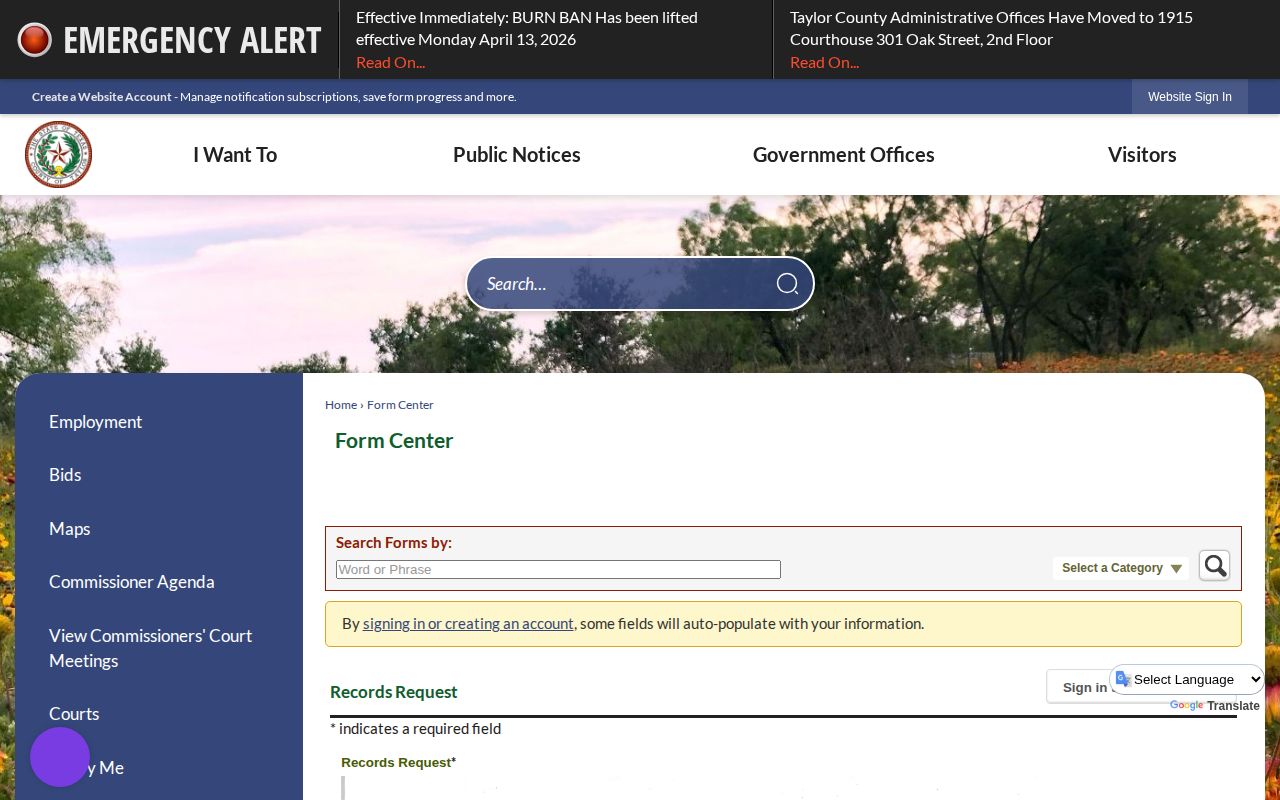
The captured form demonstrates where to begin, while the narrow wording above helps the Records Unit identify the booking-out document rather than a broad name-only summary.
Taylor Release Request Hours Conflict
Taylor County’s own Records page presents two different schedules. Its narrative lists 7 a.m. to 6 p.m. Monday, Tuesday, Thursday, and Friday, plus 7 a.m. to 5 p.m. Wednesday. A contact card on the same official page lists Monday through Friday from 8 a.m. to 5 p.m. This conflict makes a phone check sensible before an in-person visit.
Corrections should be tied to an authoritative source. Supply the booking number and the court disposition, expunction order, or nondisclosure order that supports the requested change. Ask for correction or redaction without sending more sensitive information than the office requires. An expunction under Texas Code of Criminal Procedure Chapter 55A can require covered records to be destroyed or deleted. Nondisclosure is different and has statutory exceptions.
The official records-method page is shown below so the conflicting schedule and written-request channels can be checked at the source.
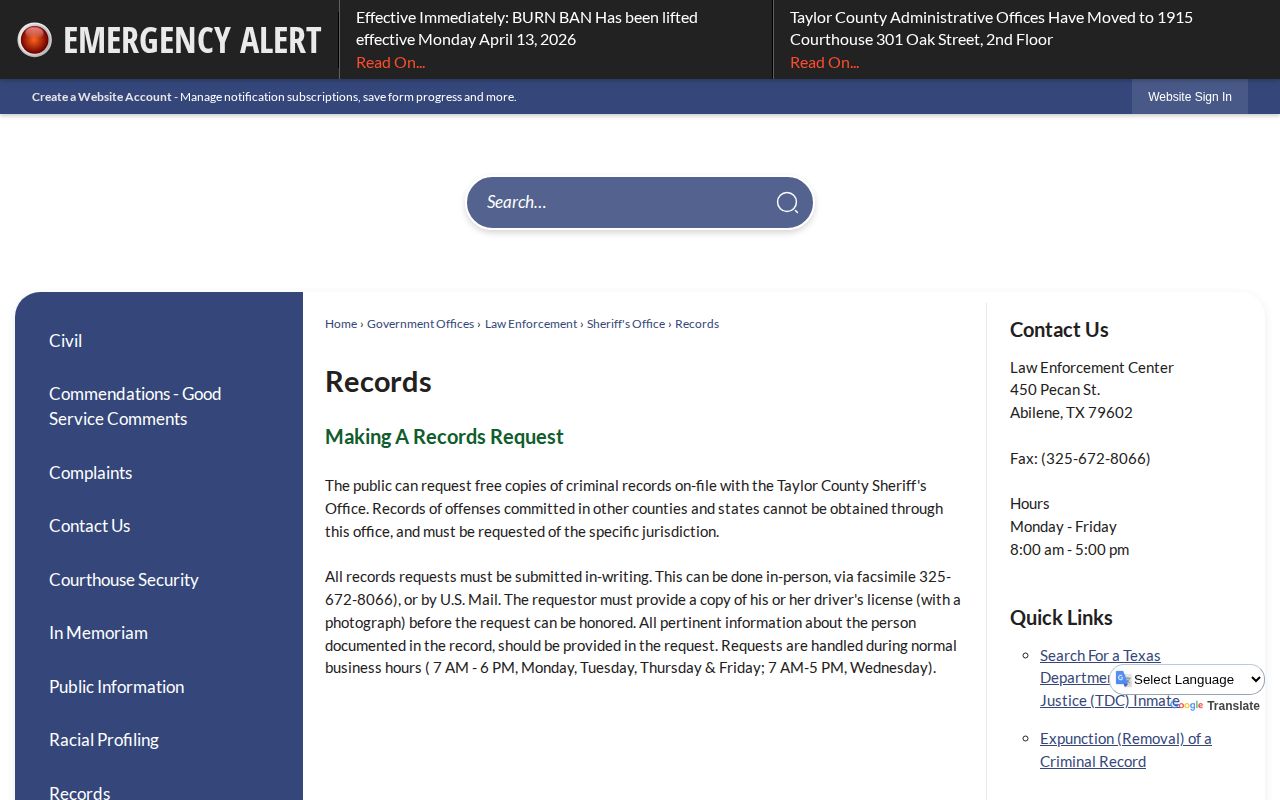
The screenshot records what the county published when captured; callers should still confirm current hours because posted details may change.
Taylor County Release Records Law
Texas Government Code Chapter 552 is the Public Information Act. Section 552.021 establishes access to public information, and §552.221 calls for prompt production as soon as possible under the circumstances. It does not promise automatic delivery within ten days. The ten-business-day framework chiefly concerns an agency seeking an Attorney General ruling when it claims an exception.
Section 552.108 can protect some law-enforcement information, while subsection (c) preserves basic information about an arrested person, arrest, or crime unless another law controls. Juvenile, medical, sealed, expunged, identifying, and active-investigation material may be confidential or excepted. Request segregable public fields and let the custodian apply any lawful redaction.
Texas State Library Local Schedule PS series PS4200-10 encompasses booking-in/out, commitment, transport, transfer, release documents, and copies of court orders authorizing custody changes. It confirms a documentary record series beyond a live roster. It does not establish how long Taylor County leaves a row visible online or prove one fixed local retention period. Ask the Records Unit whether the responsive release record is electronic, archived, and subject to the county’s adopted retention schedule.
Taylor Release Proof Crosses Offices
The Sheriff and the clerk answer different questions. A Taylor County booking-out record establishes when the custodian processed departure and may identify the release authority or receiving agency. The Taylor County Court Records Inquiry and the correct clerk establish what the judge ordered, how jail credit was treated, and how the charge ended. Neither source replaces the other.
Start with the cause number from the booking record. Felony files ordinarily belong to the Taylor County District Clerk, while county-level criminal cases ordinarily belong to the County Clerk. Review the judgment, bond or release order, dismissal, sentence, commitment, and later modification or discharge order. The public-access portal can encounter certificate or login trouble, so use the correct clerk when the online path fails.
A court order can authorize release before jail staff complete the physical departure process. Likewise, a booking-out entry can show that Taylor County custody ended without proving dismissal or acquittal. State both facts when they differ.
Search Taylor County Released Inmates
Begin with custody class and the last confirmed custodian. Taylor County does not publish a verified rolling 24-hour or 72-hour release feed. The public county inquiry may assist with a current check or case trail, but a current list cannot reconstruct prior departures. The documentary fallback is the Sheriff’s booking-out record.
- Run the official Taylor County inquiry with the exact name and any booking number. Do not treat a negative result as release proof.
- Call the Adult Detention Center at (325) 691-7423 and ask whether the person is presently in Taylor County custody and whether a public departure date or receiving agency can be given.
- Request the booking-out record for documentary confirmation. Then match its cause number to the court docket.
- Check county SAVNS for a reported custody-change event. Treat an alert as a prompt to verify, not a final legal record.
- If transfer is possible, move to the receiving system: TDCJ for state custody, BOP for a federal prison record, or ICE for current immigration detention.
The separate 24-Hour Releases and 72-Hour Releases resources preserve these short-window fallback paths without presenting an unverified feed as county data. For an auditable answer, record the spelling, identifiers, source, and time of every check.
Taylor County TDCJ Release Search
The TDCJ offender search covers state prisoners and some people released to parole or mandatory supervision. It is not an archive of Taylor County jail stays. A person who served only a local sentence may have no TDCJ record. After a county-to-state transfer, intake indexing can also lag.
| Search field | Use | Matching note |
|---|---|---|
| First and last name | Broad person search | Confirm exact spelling, suffixes, and other identifiers |
| Sex and race | Narrows a name search | Use only to distinguish a lawful match |
| Seven-digit TDCJ number | Strong state record match | Preferred when known |
| SID number | Texas identifier path | Compare the resulting conviction details |
Open the detail and compare conviction county, court, offense, sentence date, current facility or status, maximum sentence date, parole eligibility date, projected release date, and parole-review information. These labels describe different events. A projected date is not an executed release, and parole approval can precede release while conditions or processing remain.
The official interface below shows the state search channel for a Taylor County conviction or transfer.
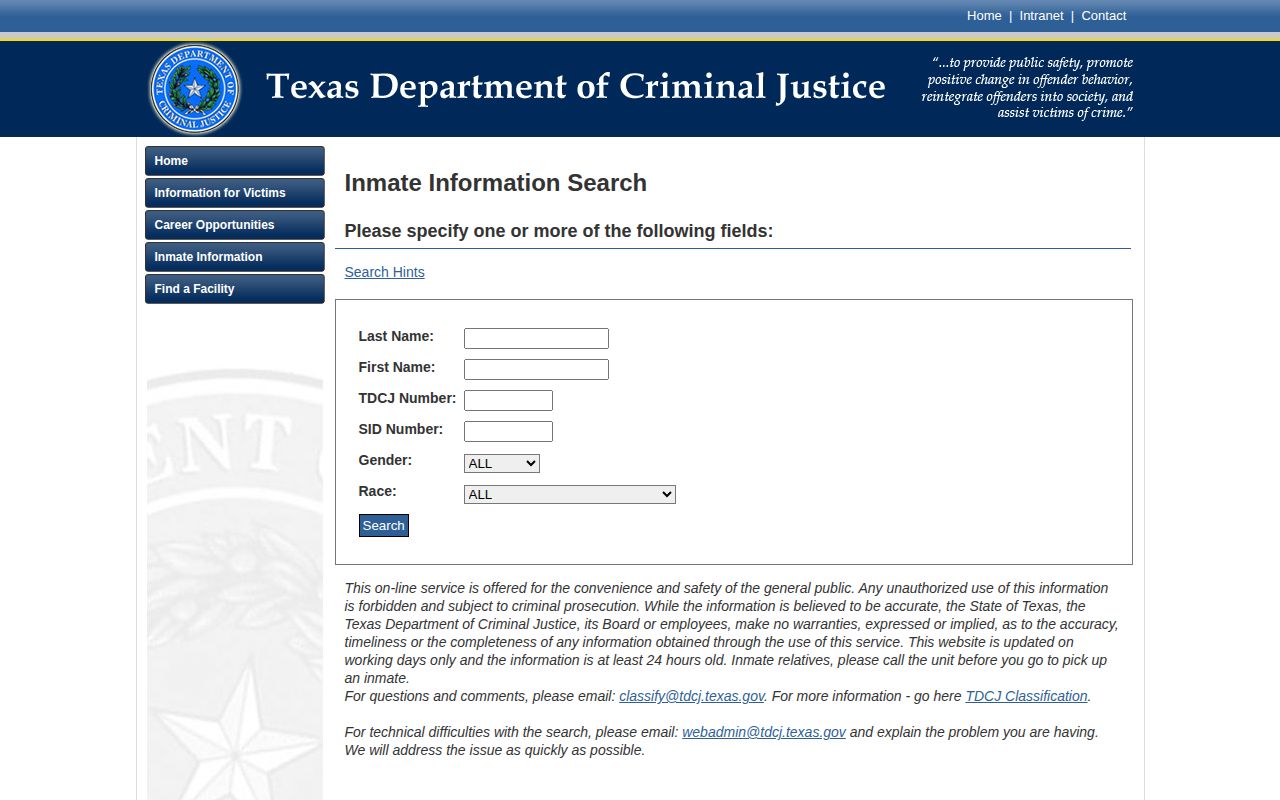
The state result should be matched back to the Taylor County cause and booking record so county departure is not mistaken for state discharge.
Taylor Release Supervision and Alerts
Texas divides post-release roles. The Board of Pardons and Paroles makes parole and discretionary mandatory-supervision decisions. The TDCJ Parole Division supervises state releasees. Taylor County Community Supervision and Corrections Department handles adult probation ordered by a court. An Abilene conviction does not guarantee assignment to a local parole office, so verify the current office through the state record.
- Parole
- Conditional state-prison release while the person remains in the state’s legal custody.
- Probation
- Court-ordered community supervision, which is not the same as parole.
- Mandatory supervision
- A statutory state release mechanism whose eligibility and approval depend on Texas law and the record.
- Discharge
- The legal end of a sentence when the official record supports that status.
Texas also has two notification layers. County jail and court events flow through Texas SAVNS or IVSS-Counties. TDCJ prisoners and parolees use TDCJ IVSS. Registration in one layer should not be assumed to follow a person into the other. Alerts can report release or transfer events, but the agency record remains the source for exact status. See VINE Inmate Check and Post-Release Supervision for the appropriate path.
Abilene-Labeled Releases Outside Taylor
Not every prison described with an Abilene reference is in Taylor County. The Middleton and Robertson Units are in neighboring Jones County according to the official TDCJ unit directory. Robertson is described as ten miles northeast of Abilene and has a regional release role. It can matter to a person sentenced in Taylor County, but it is not a Taylor County detention facility.
Use the official Robertson Unit entry and the person’s current TDCJ detail to identify the correct unit. A release processed through Robertson belongs to the TDCJ chain. The Taylor County jail record still documents the earlier county departure or transfer, while the state record documents later prison release or discharge. Location wording alone should never determine which agency holds the controlling record.
Taylor Releases to Federal Custody
A Taylor County booking-out disposition naming a federal or immigration agency is a transfer, not proof of freedom. For a federal prison sentence, the BOP inmate locator covers federal inmates from 1982 forward and may show a release date for someone no longer in BOP custody. A U.S. Marshals Service detainee housed in a contract bed may not yet have a useful BOP record, so the federal case and county transfer record can be more informative.
The BOP interface provides the federal path when a Taylor County departure led into a Bureau of Prisons record.
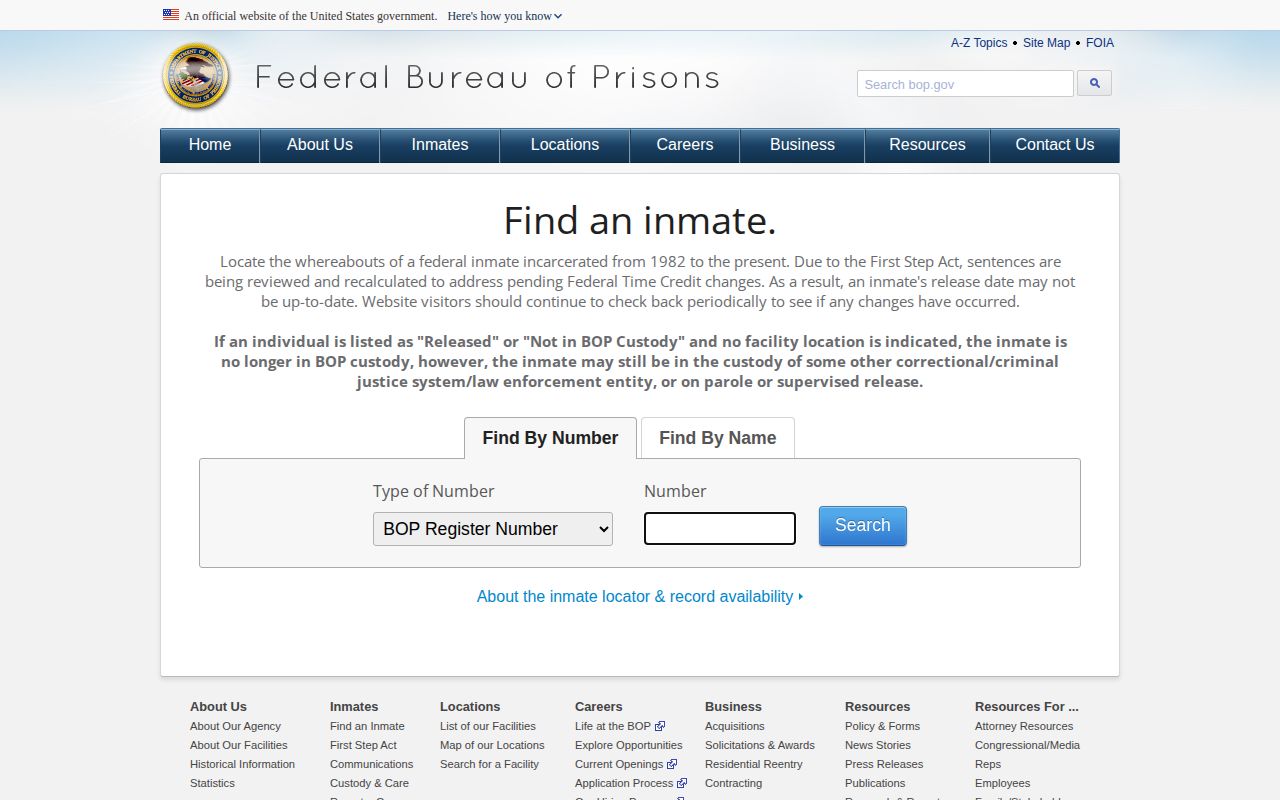
A BOP release date confirms the federal event shown by BOP; it does not retroactively identify the Taylor County booking-out reason without the county record.
Taylor ICE Release History Limits
The Adult Detention Center has ICE audit documents from 2007 and 2008. Those historic records do not establish current ICE use, a present contract, or a person’s current location. When a Taylor County release disposition says ICE, report it as a transfer to immigration custody and check the current ICE Online Detainee Locator System.
ODLS accepts an A-number with country of birth or biographical search fields. It addresses present immigration detention, not the outcome of the state criminal case. Some people may not appear or may appear after a delay, so the ICE Enforcement and Removal Operations contact route is the fallback for a lawful interested person. Do not say Taylor County deported someone. The county can transfer custody; federal authorities make later immigration decisions.
Taylor Released or Still Held
Each system has a narrow scope. Use the record that answers the custody question at hand, then cross-check the legal outcome separately.
| System | Best use | What it cannot prove alone |
|---|---|---|
| Taylor County current inquiry and jail | Present local custody | Why a missing name disappeared |
| Sheriff booking-out record | County departure time, type, and possible recipient | Later release from another agency |
| Taylor County court and clerk | Order, judgment, sentence, and disposition | Exact physical gate time |
| TDCJ offender search | State custody, release dates, and supervision fields | A county-only jail stay |
| BOP locator | Federal prison status and displayed release date | USMS, ICE, state, or county custody generally |
| ICE ODLS | Current immigration detention | Criminal case disposition |
Records can be delayed, incomplete, corrected, sealed, expunged, or matched to the wrong person. Confirm with an official number and at least one other non-sensitive identifier. A bond is not dismissal, parole is not discharge, transfer is not freedom, and a projected date is not an actual release.
Taylor County Release Facilities
The Taylor County Adult Detention Center at 910 S. 27th St. in Abilene is the main adult county jail. It holds people after local arrests, during pretrial custody, for some short county sentences, and while awaiting transfer. Its booking-out record is the primary historical proof that Taylor County physical custody ended.
The Taylor County Juvenile Detention Center at 889 S. 25th St. is a separate secure facility serving ages 10 through 17. Juvenile release may mean return to a parent or guardian, placement, or transfer under juvenile-court authority. Juvenile information has stricter confidentiality rules. Adult search tools must not be used to expose youth custody data; an authorized parent, guardian, attorney, or other eligible person should contact the juvenile justice channel.
No TDCJ prison or current federal prison was identified within Taylor County. State, federal, and immigration paths remain relevant only when the record shows a transfer or sentence under those agencies.