
Taylor County Parole or Probation
Texas assigns parole and probation to separate authorities. The Texas Board of Pardons and Paroles decides parole and discretionary mandatory-supervision matters. The TDCJ Parole Division then supervises a person released under one of those state mechanisms. Taylor County Community Supervision and Corrections Department, or CSCD, administers adult probation ordered by a Taylor County court. The conviction county does not by itself identify a parole office because residence and approved placement may control assignment.
Probation can be imposed instead of confinement or as part of a court sentence. Parole occurs after part of a state prison sentence has been served. A person released from the Taylor County Adult Detention Center on bond is not thereby on probation. Likewise, a Board approval is not proof that a prisoner has passed through the gate. The live TDCJ status, Board result, and court order must be read together.
| Point | Parole or mandatory supervision | Probation |
|---|---|---|
| Authority | Texas Board of Pardons and Paroles | Sentencing court |
| Administrator | TDCJ Parole Division | Taylor County CSCD |
| Where to verify | TDCJ detail, Board status, assigned parole office | Court docket, signed order, CSCD |
| How it ends | Official state discharge or other final action | Court-ordered discharge, early termination, revocation, or term completion |
- Parole
- Conditional release from state prison while the person remains in the state's legal custody.
- Probation
- Court-ordered community supervision, which Texas statutes often call community supervision.
- Mandatory supervision
- A statutory state release process that can require Board approval and continued supervision.
- Discharge
- The legal end of the applicable sentence or supervision term, when the official record supports it.
Check Taylor County Release Supervision
Begin with the type of custody that ended. A county-jail booking, a TDCJ prison term, and a federal sentence lead to different supervision systems. For a TDCJ prisoner, the official TDCJ offender search can show identity, current status, parole-review details, and dates. For a county probation case, use the Taylor County Court Records Inquiry and obtain the signed order from the proper clerk when a docket line is unclear.
- Match the exact legal name and, when available, the TDCJ, SID, booking, or cause number.
- Determine whether the person served a TDCJ sentence or received community supervision from a court.
- For state release, read the TDCJ detail and parole-review field, then confirm the current result with the Board status line.
- For probation, inspect the sentencing order and later docket entries for modification, revocation, early termination, or discharge.
- Contact the assigned Parole Division office or Taylor County CSCD when reporting duties or present supervision must be confirmed.
A TDCJ search is not the Taylor County jail archive. Someone who served only a local sentence may have no new TDCJ record. Conversely, a TDCJ result that lists Taylor County as the conviction county does not prove that the person was released within Taylor County. The complete county search and release-record chain is described on the Taylor County released-inmates home page.
Taylor County Supervision Offices
Taylor County CSCD is the local path for judicial community supervision. For parole or mandatory supervision, use the statewide Parole Division directory because an Abilene conviction does not ensure assignment to an Abilene office. The Board makes the release decision but does not perform day-to-day field supervision. When exact instructions matter, confirm them with the office named in the current state record.
State parole contacts
Texas Board of Pardons and Paroles
Main office: (512) 406-5452
Parole status line: (844) 512-0461
TDCJ Parole Division
Office and supervision information
The Taylor County docket identifies the court for a probation matter. Felony court records ordinarily route through the District Clerk, while county-level criminal cases route through the County Clerk. Ask for the actual order rather than relying on a short docket label. A court order can define the term and later prove discharge, but it does not establish the exact minute a jail release occurred.
Taylor County Parole Review Records
Ordinary Texas parole consideration does not use a county public hearing calendar. The Board describes a file-review process. Three-member panels review cases and vote in sequence, with two matching votes deciding the case. The Parole Division identifies cases before review, an Institutional Parole Officer prepares the summary, and notices go to the required officials and registered victims. Individual review information is found through TDCJ or the Board status line, not through a Taylor County calendar.
The official Board vote-code legend distinguishes results. FI-1, FI-2, and program-conditioned FI-R results are approvals with different timing or prerequisites. NR, SA, and DMS are different denial outcomes. An approval can be reconsidered or rescinded, and a program or future-date condition may remain. Report the exact code, then check live custody status before calling the person released.
The official parole results page shows the route used to obtain a result.
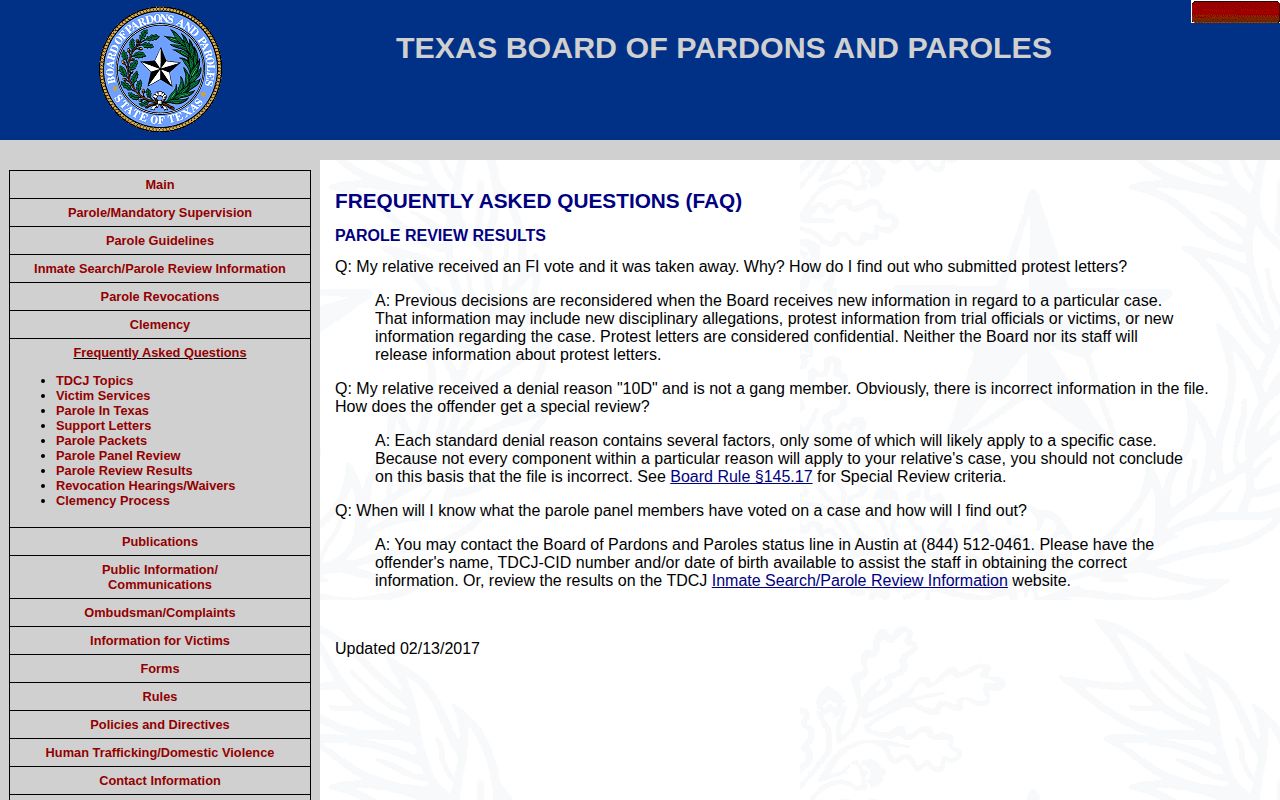
That result is one part of the chain; current TDCJ status establishes whether release to supervision has actually been recorded.
Taylor County Supervision Violations
An absconder is a supervised person alleged to have stopped reporting or whose location is unknown under agency rules. A blue warrant is a common term for a Texas pre-revocation warrant tied to alleged parole or mandatory-supervision violations. Neither term means the original sentence has been discharged. A person may be held in the Taylor County jail while the Board process continues.
Revocation proceedings differ from the ordinary parole file review. Board materials describe preliminary, revocation, and mitigation hearings, plus outcomes that can continue supervision, impose sanctions or an intermediate placement, or revoke release and return the person to prison. A warrant list is not a recent-release list. Absence from a public list does not prove that supervision is in good standing.
County SAVNS can report a Taylor County custody event, while TDCJ IVSS covers state prisoners and parolees. Registration in one layer does not automatically carry into the other. Notifications are useful alerts, but a precise claim about supervision or discharge still requires the responsible agency's record.
Note: Records may lag, omit sealed material, reflect a wrong-person match, or later be corrected, so identifiers and current agency confirmation remain essential.
Taylor County Supervision Corrections
Taylor County's official Sheriff's Records page requires written requests and a copy of the requester's photo driver's license. Its narrative and contact card publish different office-hour ranges, so call before visiting. Send identification only by a method the office confirms as secure. Include the booking number, cause number, and exact date range so staff can distinguish a jail record from a broad local-history request.
For a correction, cite the authoritative source: the booking number and booking-out record, a signed docket disposition, or an expunction or nondisclosure order. Ask for correction or lawful redaction without sending more private data than the office needs. Government records can be delayed, incomplete, sealed, expunged, matched to the wrong person, or corrected later. A booking does not prove guilt, bond is not dismissal, parole is not discharge, and a transfer is not community release.
This local process matters because a supervision conclusion may rest on both jail and court records. The Sheriff's record establishes departure from county custody. The court or TDCJ record establishes whether probation, parole, mandatory supervision, or discharge followed. Those custodians answer different parts of the question.
Taylor County Supervision Discharge
Supervision ends only when the responsible authority records that result. For probation, the court file can show expiration, early termination, revocation, or a discharge order. For TDCJ parole or mandatory supervision, use the current state status and agency confirmation. Do not infer discharge merely because a person no longer appears in Taylor County custody or because the Board once approved parole.
Government Code Chapters 498 and 508 govern key Texas good-conduct, parole, mandatory-supervision, and revocation issues. Eligibility is not release, and release to supervision is not the same as sentence completion. Government Code section 508.283 addresses time credit after revocation, while sections 508.145 and 508.149 address eligibility and exclusions. The offense date and operative judgment matter, so a generic percentage cannot replace the displayed TDCJ dates and official order.
Keep the source and access time with any conclusion. A refreshed TDCJ record, later court order, or corrected jail file may change what can be said. Exact identifiers reduce false matches, while direct confirmation prevents a transfer, warrant hold, or supervised release from being mislabeled as final discharge.