
Taylor County Release Date Meaning
A projected release date is a calculation, not proof that a person left custody. TDCJ may display that field beside a maximum sentence date, parole eligibility date, and parole-review information. Each answers a different question. The maximum date is the calculated sentence endpoint. Eligibility marks when discretionary parole consideration may begin. A projected date follows TDCJ's mandatory-supervision or discharge rules. Board review dates concern a decision process, not a gate departure.
A Taylor County pretrial detainee has no fixed projected release date. Release depends on bond, court action, completion of holds, and jail processing. A person serving a local sentence may have a jail computation based on the judgment, credit, and other causes. A state prisoner has the TDCJ calculation. Mixing those systems creates false certainty.
Find Taylor County Release Dates
First classify the custody. The Taylor County Adult Detention Center holds recent arrestees, people awaiting trial, some local sentences, and people awaiting transfer. TDCJ controls dates after state intake. The county court record supplies the judgment and credit order, while the custodian executes the sentence. Preserve the booking number, TDCJ number, cause number, exact name, and access time.
- For county custody, check the official inquiry and call the jail at (325) 691-7423. Ask whether the person is currently held and which public date or release authority staff can confirm.
- Obtain the judgment or commitment from the Taylor County court record. Do not turn a bond setting or court date into a projected departure.
- Request the booking-out record or individual jail computation from Sheriff's Records when a local sentence is involved.
- For state custody, use the TDCJ offender search by seven-digit number, SID, or exact name and identifiers.
- Read Projected Release Date separately from Maximum Sentence Date, Parole Eligibility Date, and review information.
- If the online result is unclear, email pia@tdcj.texas.gov with the full name and TDCJ number, or exact birth date or approximate age and county of conviction.
TDCJ says its listed information service has no charge. Its detail may also show conviction county, court, offense, sentence date, facility, and status. A Taylor County conviction does not mean release will occur at the county jail. Likewise, a person who served only a local misdemeanor sentence may never have a new TDCJ record.
Texas Release-Date Credit Rules
Texas Government Code Section 498.003 governs TDCJ good-conduct time classifications and credits. Good time can combine with calendar time for eligibility calculations where the governing law permits. It does not erase the sentence, create a vested right to release, or guarantee parole. Credits can be forfeited after discipline. Offense date and offense type matter because Texas rules changed over time.
Sections 508.145 and 508.149 provide offense-specific parole and mandatory-supervision rules. Texas has no honest universal “serve 85 percent” formula. A serious-offense provision often discussed in public uses a one-half or 30-year cap calculation under Section 508.145(d) for listed offenses, and good-conduct time does not reach that threshold. Other subsections use other formulas. The federal good-time shorthand is not Taylor County or TDCJ law.
The official Texas statutes gateway is the source for the current code. Read it with the operative judgment and TDCJ's displayed fields. A percentage estimate based only on sentence length can miss exclusions, offense-date rules, consecutive cases, jail credit, and Board discretion.
Taylor County Dates Can Change
A displayed date is a snapshot. TDCJ recalculates when custody, credit, court, or Board information changes. Taylor County jail staff may also be executing more than one cause or an outside hold. Record the date accessed rather than presenting a screenshot as a promise.
| Factor | Effect on the date or departure |
|---|---|
| Credit correction | Added or corrected jail credit can change the calculation. |
| Discipline | Loss or restoration of eligible good time can move a TDCJ projection. |
| Amended judgment | A court correction, concurrent or consecutive term, or new cause changes the legal basis. |
| Detainer or hold | The person may leave one custodian but transfer to another instead of entering the community. |
| Board decision | Approval, denial, rescission, future-date, or program conditions affect state release processing. |
| Data correction | Identity or calculation errors can be revised after the public result was viewed. |
A Board approval is not an executed release. FI-1, FI-2, and program-conditioned votes have different terms. Release can still await a program, plan processing, specified date, or hold resolution. Report the vote code and current custody status together.
Confirm Taylor County Release
On the expected day, check current custody. For a county booking, call the Adult Detention Center and obtain the booking-out row with release date, time, type, authority, and transfer destination if public. The court docket can prove what the judge ordered but usually not the minute jail processing ended. Pair the two records when precision matters.
For TDCJ, refresh the offender detail and use the written information route. A status of parole or mandatory supervision means conditional release while the person remains in the state's legal custody. Discharge means the sentence's legal end only when TDCJ uses that label. The Taylor County VINE inmate check explains separate county SAVNS and TDCJ IVSS alerts.
Federal and immigration holds require different checks. BOP can show a release date for a federal prisoner with a BOP record. ICE ODLS locates current immigration detention. Neither is a Taylor County projected-date calculator, and transfer to either custodian is not community release.
TDCJ Projected Date Logic
TDCJ's official inmate-information page defines Projected Release Date by offense date and eligibility. For mandatory-supervision-eligible offenses before September 1, 1996, it says release occurs on the projected date if parole has not occurred. For eligible offenses on or after that date, mandatory supervision is discretionary with the Board. If release is not approved or the offense is ineligible, TDCJ uses discharge as the projected date.
That definition is why the label cannot be treated as an appointment. Parole eligibility can arrive earlier without producing release. A Board review can end in denial or a conditioned approval. The maximum sentence date can also differ from the projected date. Ask TDCJ for the current field and incarceration history rather than subtracting time from the sentence.
The official projected-release information page is shown below. Its labels and written-request route are more reliable than an old copied result.
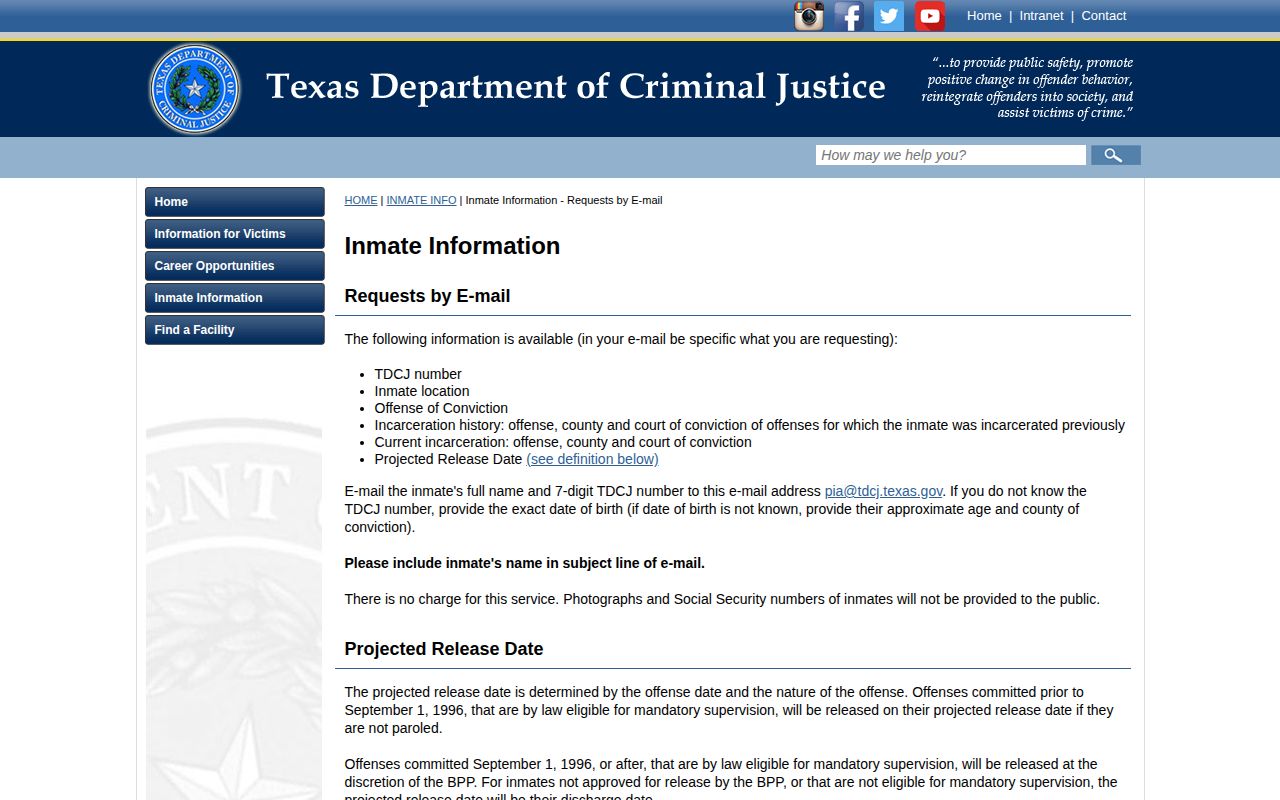
The source makes the calculation conditional and supplies the no-charge request path when an online result needs clarification.
Taylor County Jail Computations
A local jail sentence is not calculated by the TDCJ public search. Taylor County executes the court's commitment with calendar time, ordered presentence credit, cause structure, lawful local credit, and active holds. Multiple causes may run concurrently or consecutively. Release on one cause does not defeat another warrant or detainer.
Taylor County publishes no verified blanket three-for-one multiplier. It also publishes no fixed gate-release schedule. Obtain the individual computation, judgment, and booking-out record. If the record says “time served,” report that disposition without reverse-engineering an unsupported credit formula.
A weekend or holiday does not guarantee early release. Ask what date and time the commitment authorizes and when processing was completed. Property return, transport, bond verification, or another administrative task may affect departure time without changing the legal date.
No Taylor County 85% Rule
The most important Taylor County release-date quirk is the absence of one valid statewide percentage. TDCJ's calculation turns on offense date, offense nature, statutory eligibility, Board discretion, credit status, and sentence structure. The county jail also publishes no universal local multiplier. Those two gaps make a generic 85 percent answer especially misleading.
Use the operative judgment and current agency calculation. For state cases, compare the projected, maximum, eligibility, and review fields. For local cases, request the commitment and jail calculation. If a legal credit dispute remains, TDCJ, the sentencing court, or qualified counsel must resolve it.
Records may be delayed, incomplete, corrected, sealed, expunged, or matched to the wrong person. A projection is not actual release, transfer is not freedom, parole is not discharge, and disappearance from a roster is not proof of release.
Keep a dated copy of each agency response, then recheck the live source. A transfer or intake lag may explain why Taylor County and TDCJ seem to conflict. Ask for the release authority and receiving agency, not just a date, when another cause or hold is possible. That narrow question distinguishes community release from movement to another county, state prison, federal custody, or immigration detention.
Public Record Search
Sponsored Results